Tuesday, September 10, 2013

A Simple Plan, Well Executed(?)

All,
    I just finished up with the Castro OOB, so here is the Operational Plan for the liberation of Cuba, as well as the CLA OOB.


In the overall scheme of things, the Western end of the island is very lightly defended, presents an easy approach to supplanting Castro in Havana (which the CLA leadership believes will have a tremendous impact on the will of the regime's forces), and is geographically protected by the small range of mountains immediately east of Havana, and the Escambray Mountains in the center of the island, though Cienfuegos and its three battalions (one armored) will have to be dealt with in the near term.

Cuban Liberation Army OOB (ground combat elements only):

1st Airborne Infantry Battalion (screen Pinar del Rio/La Fe)
2nd Airborne Infantry Battalion (screen Cienfuegos/Bay of Pigs)
3rd Infantry Battalion (Landing Force-La Fe)
4th Infantry Battalion (Follow on Force- La Fe)
5th Armored Battalion (Follow on Force- La Fe)
6th Infantry Battalion (Landing Force- Bay of Pigs)
7th Infantry Battalion (Follow on Force- Bay of Pigs)
8th Popular Force Battalion (Havana)
9th Popular Force Battalion (Matanzas)
10 Popular Force Battalion (Jaguey Grande)

The plan calls for amphibious assaults in two locations simultaneously: 1) the Bay of Pigs will see two infantry battalions (6th and 7th Inf Bns) deposited there by small craft, with an airborne infantry battalion (2nd AB Bn) dropping due east (at El Rincon, on Hwy 122 between the Bay of Pigs landing beaches and Cienfuegos) to screen Cienfuegos; and 2) at the far western end of the island (just outside the small port of La Fe in Guadiana Bay on the Peninsula de Guana Hagabibes.  Here the plan is for one infantry battalion (3rd Inf Bn) to land (at Playa Colorada) and invest the port so that a ship carrying a mechanized battalion (5th Armored Bn) and the CLA's final infantry battalion (4th Infantry Bn) to land.  An airborne infantry battalion (1st AB Bn) will drop to the east (just east of Sandino) to screen the garrison at Pinar del Rio.

A Popular Force battalion (8th Pop Force Bn) staging near Mariel (just west of Havana) will demonstrate towards the city, ignoring its rear and flanks (the assumption being the western landing and parachute drops will occupy the attention of the Pinar del Rio garrison to their rear), with the goal of tying down the regime Airborne and Armored forces in Havana.  A second Popular Force battalion (9th Pop Force Bn), staging near Arcos de Canasi (on the north coast between Havana and Matanzas) will conduct a forced march and demonstrate against Matanzas and its infantry battalion.  CLA leadership does not love the idea of being so aggressive in the east, particularly with a Popular Force battalion, but the decision was made to close with the enemy as opposed to establishing blocking positions between the Matanzas garrison and Havana because the Matanzas garrison could take either the coastal road or the inland road to Havana, and the blocking force could easily find itself out of position.  The remaining Popular Force battalion (10th Pop Force Bn), staging near Pedroso (north-northwest of the Bay of Pigs) will assume blocking positions on Highway 1 just west of Jaguey Grands, to halt the advance of troops from Cienfuegos should they drive on Havana, or be in a position to lend support to the Bay of Pigs landing force should things go astray.

Following the successful landings, 7th Inf Bn will swing east and link-up with 2nd AB Bn, then move along the coast to Cienfuegos, whilst the 10th PF Bn, representing the second prong of the two-prong attack, will move along Highway 1.

4th Inf Bn will move north to the coast and march to Havana, while the 3rd Inf Bn and 5th Armored Bn will move east, effect a link-up with 1st AB Bn, and reduce the Pinar del Rio garrison.  Once finished, they will move east along Highway 4 to link up with the 8th PF Bn and continue combat operations to take Havana.

6th Infantry Bn will move northwest on Highway 1 to Guines and will serve as the reserve, where it can move northwest to reinforce the Havana assault, move northeast to reinforce 9th PF Bn against Matanzas, or assume an aggressive stance towards unforeseen regime machinations.  9 PF Bn's mission is to eliminate the Matanzas garrison or at least pin it in place (do not allow escape to east or to reinforce Havana to the west), until Havana reduced and forces from that engagement can be released to assist at Matanzas.

The political leadership believes the regime's forces will crumble once Havana is taken, and possibly as soon as the population realizes Castro is no longer in control of the island nation.  CLA leadership is a bit more pragmatic, and a major point of contention in the planning process is the investment of Cienfuegos.  It is quite possible 7th Inf Bn, 2nd AB Bn, and 10th PF Bn are unable to defeat the Cienfuegos garrison, but simply pin it in place.  The decisive point of that fight will likely be when follow-on CLA forces arrive from Havana, or regime forces from Santiago de Cuba arrive, with the victor likely being whomever receives reinforcements first.  Strategically, defeat of 7th Inf, 2nd AB, and 10th PF probably means a stalemate in the Cuban liberation despite the early investment of Havana.  This is because the forces on the eastern end of the island, combined with the forces in Cienfuegos, are quite strong (1 Tank Bn, 1 Armored Bn, 1 Mech Bn, 3 Inf Bns, and 4 Territorial Bns).

The approach to tie down those forces on the eastern end of the island is multi-pronged.  On the ground side, there are approximately a dozen Unconventional Warfare (UCW) teams spread throughout the Escambray and Sierra Madre mountain ranges, with their goal being to delay the advance of regime reinforcements moving east to west.  CLA Special Operations forces are charged with a number of 'special' missions on D-Day, primarily the destruction of regime Navy forces and anti-aircraft/radar sites, though they are also charged with takng a key regime broadcast station and transmitting signals to the the Popular Force battalions as well as information operations for the Cuban populace.  If the situation presents itself, CLA SOF will attempt to kill/capture the regime's leadership.  Following that, CLA SOF will regroup via small craft and helicopters for transport east to supplement CLA UCW forces in their delaying actions.

The CLA has two squadrons of F-4 phantoms, with one designated for air superiority and one for ground attack.  At H-Hour on D-Day both squadrons will perform ground attack missions to destroy as much of the Cuban Air Force on the ground as possible.  Second tier targets are regime artillery and rocket forces and naval vessels.  Following the reduction of those targets, the focus of the ground attack squadron will be interdiction against enemy armor forces, primarily those in the east moving west in order to assist the vulnerable Cienfuegos operation.

More to come...

Castro Regime Order of Battle

All,
    In furtherance of preparing for the glorious invasion which will begin the crusade for liberation, I'm getting my administrative house in order.  Here is what I'm looking at in terms of the Castro Regime's order of battle for the upcoming campaign.


Castro's Army

Havana (Western Command)
-Revolutionary Army Command (Cuban equivalent of Pentagon/Joint Chiefs of Staff)
Castro has all 'strategic' assets centralized, under his direct control in Havana:
-51st Artillery Regiment (2 battalions of 105mm towed howitzers, one battalion of self-propelled 152mm howitzers)
-45th Air Defense Artillery Regiment (one battalion of towed anti-aircraft guns, consisting of dual 14.5mm HMGs, dual 23mm autocannons -ZU-23s-, and 37mm Bofors), and one battalion of self-propelled  guns, consisting of ZSU-57 and ZSU-23-4 vehicles).
-73rd Air Defense Regiment (one battery of six SA-2 Guideline launchers, one battery of six SA-9 Gaskin mobile launchers, and one battery of six SA-6 Gainful mobile launchers).
-82nd Rocket and Missile Regiment (one battalion of BM-21 Grad MLRS, one battery of 2 "Frog-7" ballistic missile vehicles, and one battery of six SS-1 "Scud" ballistic missile vehicles).
-1st Airborne Battalion, "Castro's Bodyguard," consisting of two companies of regular, but highly motivated infantry.
-2nd Armored Battalion, consisting of the 78th Tank Company (T-72) and the 70th Motorized Rifle Company (BMP-2).

Pinar del Rio (Western Command)
-3rd Infantry Battalion, consisting of the 27th and 28th Infantry Companies, and the 24th Provincial Militia Company.

Cienfuegos (Central Command)
-4th Infantry Battalion, consisting of the 81st and 84th Infantry Companies.
-5th Territorial Infantry Battalion, consisting of the 86th and 89th Provincial Militia Companies.
-6th Armored Battalion, consisting of the 12th Tank Company (T-34) and the 242nd Infantry Company.

Matanzas (Central Command)
7th Infantry Battalion, consisting of the 41st and 43rd Infantry Companies, and the 48th Provincial Militia Company.

Santiago de Cuba (Eastern Command)
-8th Tank Battalion, consisting of the 3rd Tank Company (T-55), the 6th Tank Company (T-34), and the 9th Tank Company (SU-76).
-9th Infantry Battalion, consisting of the 31st, 32nd, and 38th Infantry Companies.
-10th Territorial Infantry Battalion, consisting of the 84th and 90th Provincial Militia Companies.
-11th Territorial Infantry Battalion, consisting of the 95th and 97th Provincial Militia Companies.

Holguin (Eastern Command)
-Mechanized Task Force 'A' (from elements of the 12th Mechanized Battalion), consisting of the 50th Mechanized Company (BTR-60).
-13th Infantry Battalion, consisting of the 54th and 56th Infantry Companies, and the 58th Provincial Militia Company.

Camaguey (Eastern Command)
-Mechanized Task Force 'B' (from elements of the 12th Mechanized Battalion), consisting of the 60th Mechanized Company (BTR-60).
-14th Infantry Battalion, consisting of the 60th and 63rd Infantry Companies.
-15th Territorial Infantry Battalion, consisting of the 65th and 69th Provincial Militia Companies.

Airborne Company Table of Organization
HQ-CO (Capt)
       1 x 2-man ATGM  (AT-5 Spandrel)
3 Rifle Platoons, each consisting of:
Plt Ldr (Lt)
RPG
1st Squad (LMG, 3 rifles)
2nd Squad (4 rifles)

Infantry Company Table of Organization
HQ-CO (Capt), XO (Lt)
       1 x 2-man 12.7mm HMG
       1 x 2-man 82mm Mortar
3 Rifle Platoons, each consisting of:
Plt Ldr (Lt)
1st Squad (4 x rifle)
2nd Squad (4 x rifle)
3rd Squad (2-man LMG team, 2-man RPG team)

Provincial Militia Company Table of Organization
HQ-CO (Capt), XO (Lt)
       1 x 2-man 12.7mm HMG
       1 x 2-man 82mm Mortar
3 Rifle Platoons, each consisting of:
Plt Ldr (Lt)
1st Squad (4 x rifle, 1 RPG)
2nd Squad (5 x rifle)

Tank Company Table of Organization
HQ-CO (Capt), XO (Lt), both with 'jeep'-type vehicle and driver
3 Platoons, each consisting of:
Plt Ldr (Lt)
1st Squad (5 rifle)
2nd Squad (5 rifle)
Tank

Mechanized Company Table of Organization
HQ-CO (Capt), XO (Lt), both with 'jeep'-type vehicle and driver
3 Platoons, each consisting of:
Plt Ldr (Lt)
1st Squad (3 rifle, 2-man LMG team)
2nd Squad (3 rifle, 2-man RPG team)
Armored Personnel Carrier


Castro's Air Force

Havana (Western Command)
1st Interceptor Squadron (12 x MiG-21)

Pinar del Rio (Western Command)
2nd Interceptor Squadron (12 x MiG-21)

Artemisa (Western Command)
3rd Ground Attack Squadron (12 x MiG-27)
4th Bombardment Squadron (8 x TU-95)
5th Rotary Attack Squadron (12 x Mi-24)
6th Transport Squadron (10 x Mi-8)

Guines (Western Command)
7th Ground Attack Squadron (12 x Su-25)
8th Rotary Attack Squadron (12 x Mi-24)

Santa Clara (Central Command)
9th Interceptor Squadron (12 x MiG-21)
10th Ground Attack Squadron (12 x MiG-27)
11th Rotary Attack Squadron (12 x Mi-24)
12th Bombardment Squadron (12 x Il-28)

Holguin (Eastern Command)
13th Interceptor Squadron (12 x MiG-21)

Camaguey (Eastern Command)
14th Interceptor Squadron (12 x MiG-21)

Bayamo (Eastern Command)
15th Ground Attack Squadron (12 x Su-25)
16th Rotary Attack Squadron (12 x Mi-24)
17th Transport Squadron (10 x Mi-8)

Castro's Navy

Matanzas (Central Command)
1st Flotilla (3 fast attack/coastal patrol craft)

Puerto Padre (Eastern Command)
2nd Flotilla (3 fast attack/coastal patrol craft)

Santiago de Cuba (Eastern Command)
3rd Flotilla (3 fast attack/coastal patrol craft)
4th Flotilla (2 armed corvettes)

Obviously these are much reduced from real life (for a frame of reference, I used real-life Division numbers for the company numbers).  Perhaps it's a bit hokey, but I'm going to play out a campaign using skirmish rules, so I really needed to pare the forces waaaaaaaaay down.  Not only did I reduce the total number of ground units by about 80%, I also screwed around with the Tables of Organization so that I could put a "Company" on the table and fight it out with what is really about a platoon's worth of troops.  Again, this is simply a tool to help me on the tabletop.

Regarding the Air Force and Navy, I'll be honest and tell you I just made all that stuff up.  I wasn't really going to mess with it, but I figured there are assets available in real life, so I at least needed to address them.  I can tell you that my skirmish games are going to occur without off-table air and artillery support, so the CLA invasion plan is going to be heavy on eliminating these assets in the first few hours so that my tabletop games are straight up shootouts uninfluenced by the Castro regime's overwhelming numbers of air and arty.

Having said that, I've got some Vietnam aircraft upstairs, and the reason I made all those MiG-21 Interceptor Squadrons is that I believe my CLA is going to have a couple squadrons of F-4s (for air superiority and interdiction, no CAS) and I might get some air-gaming in as well.  We'll see what happens...

V/R,
Jack

Monday, September 9, 2013

Odds and Ends, AKA, Getting Some Admin Work Done

All,
    I'd like to start off with a note about my Operation Jupiter batreps, of which there are now two.  It is much to my consternation that no one seems to be interested in them.  While I'm not too put off as 1) they were fun games to play, and 2) the blog is, in the overall scheme of things, for no one but myself.  Having said that, having one of these things does draw you into the realm of wanting to have other folks look, comment on, and critique your stuff. So if you've got any critiques regarding the batreps (to make them more readable, interesting, exciting, etc...), please let me know.  Back to our regularly scheduled show...
    I'm a huge NFL fan (Steelers to be exact, though I don't want to talk about it as they severely embarrassed themselves yesterday), so gaming on Sundays is out for awhile.  But I did figure out how to make it more productive from a wargaming standpoint; I couldn't do it during the Steelers game, but during the other games I allowed myself to be distracted enough get some gaming stuff done.  Here's what I did yesterday during football:
 Some 10mm pallets from Minifigs.  From left to right, empty pallet, pallet with wooden boxes, pallet with something covered by a tarp, and pallet with 55-gallon drums.  This is all of them.
 My stone walls.  If you've been looking at my previous battle reports you will see these are the same ones I've always used, but now I dry-brushed a stone color on them and painted the wooden gates (I've got 16 stone wall sections, all finished as above).  The pic looks a bit garish, but I promise it looks pretty good in real life.  Previously they were simply spray painted dark gray.  I'm trying to up my game a bit regarding terrain.
 Sandbag emplacements.  Previously these were simply spray painted khaki (I've got 3 of these, will use them like this for temperate, tropical, and desert).
 The town fountain, previously spray painted khaki.  I only have one of these.
 Craters, previously spray painted dark brown, now highlighted with sand and reddish brown, given a little flock and a wash.  I have eight of these.
 Here's the front of the first building I did (previously spray painted khaki).
 Here's the reverse of the same building.
 Here's a top down of the same building.
 Here's the front of the second building I did yesterday.
 It's reverse...
 Reverse with the second floor removed.
 After having no fewer than 8,436,212 people on TMP and the Pendraken website tell me I need to put a wash on my figures, I decided to give it a go with some of them.  I did up my CLA regulars/paratroopers and my modern irregulars as they both had pretty bright colors.  I did not do any of my other Cuba Libre forces as they are dark already and I didn't like the test guys I did.  But I was happy with the CLA regs/paras and irregulars, so I did all of both forces.  Above and below are some examples.  I really like how they turned out, and I hate it when other people are right!


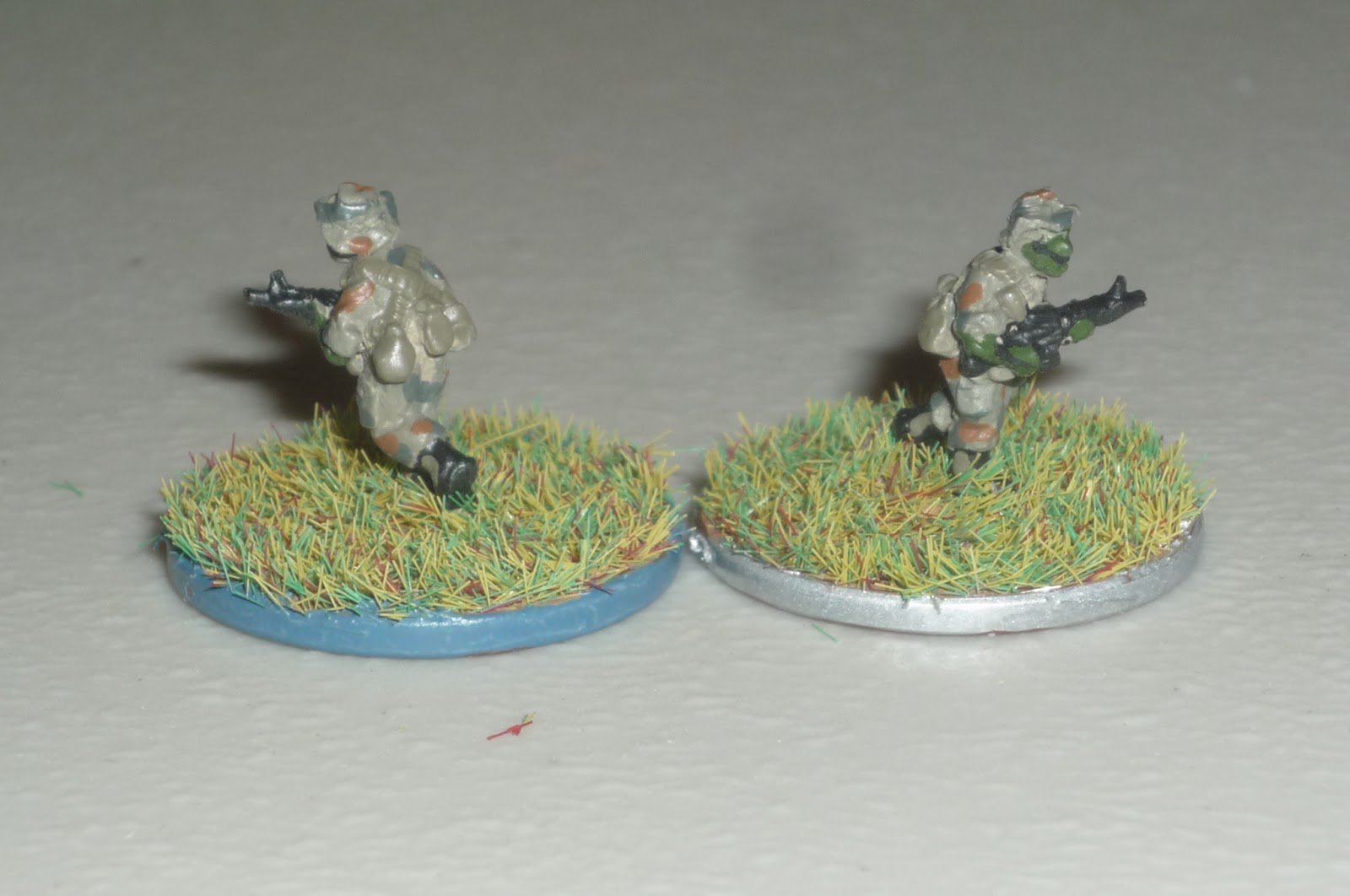
 In preparation for D-Day, I did some some CLA unconventional warfare types to serve as SF A-team types, popular force militia cadre, and LRRP/Recon types.  I did a total of 9 guys in three poses.
 Your eyes don't deceive you, and no, those aren't little 10mm Incredible Hulks.  These guys are cammied up.  The green is a little bright, but I like it because I think at this scale you really need a sharp contrast so everything doesn't just blend together (if you've been following my posts you've heard me lament trying to put gloves on guys but not being able to find a color that works).  If you look real close you can see I tried to put black stripes in their face/hand camo (it does aggravate me slightly that I chose to cammie up guys that have their sleeves rolled up to their elbows, but c'est la vie!).
    I tried putting a wash on these guys but it just darkened everything and made the uniform and skin camo blend together, giving the figure a nasty, mottled look.  Yes, I understand that is part of the point of a wash, and yes, I understand that is certainly the point of camouflage, but I like colors that pop/stand out.  I think if we wanted to be perfectly realistic at 10mm we'd just paint everything green, but I don't think that looks all that great.  So, I introduce a bit of "Hollywood" to make it a little more visually engaging (for me).


So yesterday was pretty productive, and I believe I will continue this trend to get guys based/washed and get terrain pieces down a couple at a time.  I've got some admin work to finish for Cuba Libre (I was working on Castro regime OOB last night), and I've still got a few things to figure out regarding figures for my forces, and I need buildings and to finish my palm trees, but I'm getting tangibly closer to D-Day.  I've also been a bit distracted with other stuff (I did up some 6mm Napoleonics and I did some Cuba Libre painting for the 1991 Gulf War)...

V/R,
Jack

Sunday, September 1, 2013

Castro Regime and CLA Regulars/Airborne

All,
    The weekend is ticking down with no games in, but I've been a painting (and basing) fool.  Today I finished up my Castro Regime regulars (using Pendraken Argentinians), and I finished painting my Liberation-era CLA Regulars/Airborne (using Pendraken US Vietnam range).  However, I didn't get them based up because...  I ran out of pennies!  I'll have to see if I can pick up a couple hundred new bases tomorrow...
    In any case, with all this painting and basing going on, you know what that means: the invasion draws nearer.  There's really not a whole lot left I need to get taken care of before it's time whoop it on.  I got some palm trees that I need to put flock on, and I've got a few more figures I need to get sorted out for the Liberation fight, but the biggest deal I have working against me is buildings.  All I really have in my inventory are (extraordinarily bad-looking) WW2 ruined buildings.  I've got plenty of them, but I don't know that they will work out for me in Cuba, unless our plan is to destroy every town in the process of liberating it ("we had to destroy the village to save it...").  Not sure what to do; I don't have a ton of money lying around to go out and buy some buildings, so this is gonna get interesting.
    On to the pics:
 Here's the entire Castro-regime force: 25 rifles, 3 MG teams, 3 heavy weapons teams (Blowpipes in actuality, but will serve as either SAM, ATGM, or recoil-less rifle depending on what the scenario calls for), and 5 Officers/NCOs.  These guys will probably get some camo added and then be used for the Columbia/Venezuelas war, maybe Angola, and probably the Balkans (Serbs).
 2 of the rifle poses.
 Two more rifle poses.
 The last rifle pose (top, which is the Argentinian radioman, but unlike the Brit version sporting manpack radio, this guy only has a 'walkie-talkie') and the Blowpipe team (bottom, which is the Argentinian Blowpipe and one of the Argie engineers.  On a side note, this was my plan for the engineer pack from the get-go, and Leon at Pendraken was nice enough to take out the prone engineers, leaving me 10 kneeling engineers to go with my 10 Blowpipes).
 Two of the machine gun teams.  Basing prone guys is such a pain for me, but I think they look alright.
 Castro regime leadership, straight out of the Argie command pack.
 A shot of the cheapie palm trees I got off e-bay; straight out of the bag on the left, and with some flock on the base on the right.  I'm loving these, and they open up a whole lot of new scenarios for my wargaming from WWII to present.
 I mentioned I didn't base my CLA guys because I ran out of pennies, but here are some shots nevertheless.  Again, I used Pendraken US Vietnam range, so here you have guys out of the officers pack (top) and M-79 grenadiers (bottom).  These guys will be my CLA regulars coming into the Bay of Pigs as well as the airborne units.  I have no idea what else I will/can use them for in the future (other than Vietnam War, but I mean in my Cuba Libre timeline).
 M-60 (top) and kneeling rifle (bottom).  Look at the green on those jungle boots (I get quite proud of myself when I'm able to do goofy stuff like that)!
 Two riflemen with M-16's, from the 'standing' and 'running' packs.
The battalion commander's arty: 81's (there are actually three of them in the pack).

I need to find me some pennies and get these guys done up.  I also need to do some Pendraken Vietnam range guys in boonie covers up for the CLA UCW guys that will be leading Popular Force units, flock all the palm trees, and get some suitable buildings, then it will be time for D-Day, February 1, 1990.

V/R,
Jack


Saturday, August 31, 2013

Modern Irregulars

All,
    In trying to get my stuff ready for my "Cuba Libre" project, I spend all morning painting and basing up one of the troop elements, which I suppose I'm calling my "Modern Irregulars" (don't know what else to call them).  They are from the 10mm Pendraken Falklands range, using Brit SAS and Argentinian Special Forces.  I painted them up (rather garishly in some cases) as wearing civilian clothes with a bit of military kit.
    In Cuba Libre I envision using these for:
-CLA Special Operations forces (in urban/clan scenarios)
-CLA Popular Forces (recently raised militia in the fight for liberation)
-Drug Cartels
-Hezbollah during the two incursions into Lebanon, as well as in Syria and CT ops worldwide
-Sadr militia during OIF
-IRGC for OEF, OIF, Syria, and CT ops worldwide
-Taliban for OEF (Afghan and Pakistan)
-Insurgent/Militia/Warlord hangers on for Somalia/Rwanda/Liberia
-Al Qaeda for OEF (Afghan, Pakistan, CT ops worldwide)
And those are just the ones I know of!  Of course, they will be used wherever and whenever I think they're appropriate.  Here's the pics:
 The whole force, 51 men in (only) five poses.
 Top is the Argie rifle, bottom and Argie with an SMG (which I'm using for leadership).  Hope you dig the civvies.  They're also wearing masks.  I keep wanting to put gloves on guys, but I'm having a problem with this in 10mm.  I can't seem to find a color that sticks out without looking ridiculous.  Using black or brown just seems to blend into the weapons or clothing.
 A couple of the Brit rifles, top w/SLR and bottom with M-16.
 Brit SAS w/M-203.
Here's a closeup to give you a look at the face-masks.

I'm sure they're not the most beautiful things, and I was scared for a bit when I was about halfway through painting them, but I'll tell you, I'm happy with how they turned out and I think they'll work perfectly for what I need them to do.  I mean, tell me those guys can't be Spec Ops guys anywhere in the world, or Cartel in Central America, or Hezbollah/IRGC in Lebanon.  Maybe a stretch for Iraq and Afghanistan, but I think they'll be close enough for me (though I do have some good looking Taliban from Minifigs).

Next up on the paintbench is some Castro-regime forces.  

V/R,
Jack

6mm British Line Infantry

All,
    Well, so far no games this week, and I'm not sure if any will happen this weekend either, despite the holiday weekend.  What I've been working on all week and all day today has been painting.  I got a fresh bag o'goodies from Pendraken for my "Cuba Libre" and French Indo-China projects, as well as some Baccus 6mm cavalry for my Brits and French.  So I pulled everything out, cleaned it up, glued it on popsicle sticks, and got it primed (I always use khaki).
    I spent a couple hours each evening finishing up a total of 40 strips of Brit Line Infantry.  It's cool having them done, but I still have quite a bit on my bench here at the house, and the sinking realization that I only own about 20% of what I will need to complete this project.  So not only do I need to spend a @#$-ton of cash to get there, but I also have about 3 million more hours of painting, just for my Napoleons...
    Here's what I finished this weekend:
 The whole shebang, minus the command stands, which I haven't finished.  I'm also waiting on a pack of 60 x 30 MDF bases for this project.
 My 'blues.'
 My 'greens.'
 My 'yellows.'
    My 'buffs.'  I hope this is historically accurate.  The stuff I was looking at said that the red-flagged regiments had either red or buff cuffs.  I tried a red, but it didn't stand out enough from their red jackets, so I went with buff.  Come to think of it, I think it's actually supposed to be white, but I went with buff because I wanted a different color than the crossbelts, which I wanted to really pop.

Hope you like them.

V/R,
Jack

Friday, August 30, 2013

Cuba Libre!

All,
    I'm moving ahead with my pseudo-, sort of modern Imagi-Nation.  My concept is the 'liberation' of the island state of Cuba by a government in exile, which then becomes a minor ally of the United States and small player on the international stage.  So first, my disclaimer:

The point of this scenario is simply to provide a launching board for quasi-realistic, semi-plausible 'modern' (post WWII) wargaming.  This is strictly apolitical, with no desire to become mired in real-world, factionalized argument or in-fighting.  While some actual names of world leaders, movements, militaries, and locations will be used, again this is no statement politically, socially, culturally, or morally, it is simply a vehicle to draw interesting wargames in interesting locales with a small bit of real-life history.

So, with all that being said (and hopefully understood and accepted), I now write a timeline of the Liberation of Cuba, from 1963 to the present, providing us a bit of ahistorical hindsight, with the overall goal being to map out my concept and wargaming plans:

1.  1961: Following the Bay of Pigs debacle, a group of displaced Cubans, including some survivors of the Bay of Pigs excursion, gathered in Miami, Florida, to regroup, reorganize, and devise a plan to continue their attempts to oust the Castro regime, replacing it with themselves.  The primary focus of this group is to unite displaced Cubans, primarily those residing in the United States, and to lobby the US government to support, assist, and otherwise back both soft and armed campaigns to supplant the Castro regime.  Through various US presidential administrations the "Free Cuba Government in Exile" (FCGE) was given malleable promises that amounted to only lip service to the FCGE's cause.

2.  1983: The US government intervened militarily on the island of Grenada to rescue US university students as well as to counter Cuban influence.  With the US military undertaking direct combat operations against the Cuban military, the leadership of the FCGE was sure the situation was ripe and that the US would support, if not conduct outright, an invasion of Cuba in order to depose the Castro regime.  However, the US government did not wish to inflame the situation with the USSR any further, and furthermore, the only 'invasion force' the FCGE was able to muster was a group of approximately 1200 volunteers who were unarmed, untrained Cuban exiles spread throughout the US and Caribbean.  At this juncture the FCGE decided US support would not be forthcoming now or in the future, and so a plan was set to act unilaterally.

The FCGE took steps to consolidate the various Cuban exiles worldwide, holding shadow 'democratic' elections which locked into place its power structure.  Various government branches were established (Ministries of Labor, Agriculture, Information, Economy, Law, etc...) to formalize the FCGE's place as the future Cuban government, as well as to serve as a means of redress for the varying concerns and agendas of the diverse exile population.  As part of this reorganization, the Cuban Liberation Army (CLA) was formed, with its strategic goal being the overthrow of the Castro regime by force of arms.

The leadership of the CLA focused solely on its strategic goal, and immediately devised a plan to essentially sub-divide the CLA into an unconventional warfare cadre to infiltrate Cuba and begin "grass-roots" operations to recruit, form, and train indigenous forces to support the second arm of the CLA, a force designed to 'break-in' and conduct conventional military operations against armed resistance by members of the Castro regime.

The CLA set about recruiting, forming, and training a professional force of soldiers for the upcoming, inevitable invasion of Cuba.  The CLA found recruitment relatively easy, as there seemed to be an ample supply of Cuban exiles desirous of taking part in a great campaign to 'free' their homeland, as well as a goodly amount of third country nationals willing to fight in Cuba for various reasons, such as hostility to oppressive regimes, being staunch anti-communists, a desire to see a normalization of US-Cuban relations, the desire to see free markets opened in Cuba (i.e., the desire for Cuba to become a new market), or simply being modern day adventurers.  For these same reasons, private financial backing was never really difficult to secure, easily sustaining the FCGE as well as satisfying a great deal of the CLA's procurement agenda.

A great deal of effort was made by the CLA to recruit exiles currently serving in other countries militaries; of course the military forces of the United States were worked very heavily, but recruits were also found in many Central and South American militaries, and some found as far away as Israel, Ethiopia, Sri Lanka, and the Philippines.  Indeed, upon insertion of Unconventional Warfare (UCW) elements into Cuba proper, a number of ordinary members of the population as well as members of the Cuban military forces were recruited and exfiltrated to the United States.  New recruits were 'encouraged' to join their nations' perspective militaries in order to gain valuable training, skill sets, and experience.  Overall, this method of recruitment resulted in a very experienced, battle tested force, though one that had not operated together.

Training and Staging areas were an initial conundrum for the CLA as the United States seemed the obvious choice, but its laws strictly forbade the types of things the CLA was doing and planning, and several times the CLA found itself in hardship as members were arrested and property seized after running afoul of the law, both in the US and in international waters/arms markets.  Much of this dilemma was solved when the governments of Mexico and Colombia entered into talks and agreements with the FCGE regarding the acquisition and storage of weapons, as well as the billeting and training of members of the CLA.  Ultimately these talks were successful due to a shared distaste for the Castro regime, particularly once it began supporting the sale and transfer of illegal narcotics (much like Mssr. Noriega) in the mid-1980s.

The greatest challenge facing the CLA was the fact it did not know when the upcoming invasion would occur, and a large amount of its key personnel were spread throughout the globe in ongoing military operations.

3.  February 1990: After much deliberation, in January 1989 the FCGE made the fateful decision to launch the long-awaited invasion of Cuba in January 1990.  The CLA began marshaling its forces and conducting a rigorous training schedule to prepare its forces for combat operations.  In the overall scheme of things the training could be called nothing but successful, but there were still gaping holes in key leadership positions as many of these men were still serving in their adoptive country's military, though all were able to take part in some training and exercises by taking personal leave.

The invasion was actually pushed from January 1990 to February 1990 due to the fact a significant number of key personnel were mobilized and deployed into combat operations when the US military conducted Operation Just Cause in December 1989.  Immediately following the cessation of combat operations, these men took leave and deserted the US military in order to join their comrades for the upcoming invasion (the US government later pardoned all deserters).

UCW elements had been present in Cuba for the better part of four years at this point, recruiting, conducting PsyOps missions, conducting reconnaissance and surveillance of Cuban military and government forces and facilities, establishing arms and supply caches throughout the island, forming and training "Popular Force" units comprised of members of the local population (with UCW cadres), and establishing intelligence source networks country-wide.  In the seventh months prior to the invasion (a planned six months, but one extra owing to Just Cause), the remainder of the CLA UCW were infiltrated into Cuba, where preparations for the upcoming fight were finalized.

On February 1, 1990, the invasion took place.  Airborne elements dropped in the dead of night to establish blocking positions around the beachhead, while UCW/Popular Force elements struck key units and facilities of the Cuban government and military.  Later that morning conventional forces came ashore at the (you guessed it) infamous Bay of Pigs landing site, quickly moving inland, while the fledgling CLA air force worked hurriedly to establish air superiority and deny the Cuban navy use of its coastal patrol craft.  Heavy fighting ensued, with the Castro regime putting up stiff resistance.  At one point, a Venezuelan parachute battalion dropped on the island to assist the Castro forces, led by a dashing young officer who would, upon his return to Venezuela, would take power there via military coup on a populist platform of solidarity against the Yanquis and their puppets.  This discord between Cuba and Venezuela would rear its ugly head in the not so distant future.

Though heavy fighting occurred against determined resistance, the results were never really in doubt.  The Cuban military was a shell of its former self following decades of communist corruption, over a decade of fighting in Angola, and a budget practically slashed to zero as Soviet aid dissipated (the Soviet Union had exhausted itself and was on the verge of its colossal crash and breakup).  Troops sat listlessly in their barracks, or worse, forced into labor for roads and agriculture.  Much of the Cuban military's first-line equipment had been stranded in Angola upon the Cubans' withdrawal, while the remainder sat on airstrips, slips, and vehicle parks, unused and neglected in terms of maintenance.  Due to economic hardship, two-thirds of the Cuban military's manpower was lost to desertion and budget cuts which moved a substantial portion of the Cuban soldiers out of active military units and into National Guard or Provincial units, many of which sported equipment of WWII vintage (both US and Soviet).

The FCGE and CLA also found themselves beneficiaries of the vast majority of popular support, despite the Castro regime's attempts to paint them as Yanqui puppets.  CLA PsyOps and Information Operations were very successful in countering Castro's claims (pointing at CLA aircraft and exclaiming "there are no stars on those wings!  Cuba for Cubans!" soon became a battlecry), and this coupled nicely with a population still able to remember life before Castro and willing to contrast that experience with the current situation.  This support swelled the ranks of the CLA's Popular Forces and provided a steady stream of intelligence on the Castro regime's movements and intentions.

I am not putting in a date for the successful resolution/end of fighting as I don't know when that will be, it will depend on what happens on the tabletop.  All I know is that it will (must?) be successful and won't last past January 1991, because...

4.  January 1991: The new Cuban government consolidates power, establishes itself as an interim government and holds elections not long after, with little change as the leadership is largely held as heroes owing to its success in casting off the Castro regime.  It is quickly recognized by most nations (the Western nations in particular) and the UN, and becomes a close ally of the United States.  The most significant issue to hand for the international community was Saddam Hussein's August 1990 invasion of the oil-rich nation of Kuwait and the US preparing an international coalition to expel Iraqi forces from Kuwait.  Cuba, desiring to become a player on the international stage, quickly organized to provide a force to take part in Operation Desert Storm.

The Cuban military quickly reorganized itself.  The majority of the military was subdivided into two parts: the vast majority formed the Cuban National Defense Forces, which, as the name suggests, concerned itself solely with defense of the homeland.  The remainder, formed largely from former members of the CLA, was organized into the Cuban Expeditionary Force (I do not intend to have any further fighting in Cuba, so the remainder of my wargaming will concern itself only with the CEF).  The vast majority of the CEF was quickly dispatched to the Kingdom of Saudi Arabia, where it formed, refit, and trained to participate in Desert Storm.

As a relatively small force, and, due to the large expanse of desert to be covered and crossed, the United States agreed to provide heavy equipment the CEF.  A number of M1A1 Abrams, AAV7 amphibious armored vehicles, LAV-25 armored cars, and HMMWVs were provided to allow the CEF contingent to perform as a mechanized Cavalry Brigade.  The US also supplied a detachment of AV-8 Harriers and UH-60 Blackhawks, which the CEF combined with a Command Element and Combat Service Support Element to form an Air-Ground Task Force ("Task Force Cordova") on the USMC MAGTF model.  Additionally, highly-trained operators of the CEF were provided rotary assets and placed under the command of US special operations forces to conduct Visit, Board, Search and Seizure (VBSS) missions on Gulf shipping as well as raids on Gas and Oil platforms in the Gulf.

Task Force Cordova was charged with being a lead element to conduct reconnaissance for initial breach of Iraqi defenses on the Saudi-Kuwait border, then to perform classic screening operations during the advance through the open desert to Kuwait City, then to screen the city while coalition allies took the city.  In the event, fighting was extraordinarily heavy (ahistorically, but remember the casualty projections?) at the berm and through the Iraqi defense in depth, with TF Cordova facing particularly heavy opposition when leading the advance and becoming encircled when coalition allies proved less than enthusiastic/aggressive.  TF Cordova then served as a 'fire brigade' in the fighting through the initial defensive line, screened during the advance to Kuwait City, and then once again became a fire brigade during the intense fighting in the city.  Their toughness and tenacity drew accolades from General Schwartzkopf and international renown for Cuba's martial prowess.

Meanwhile, the CEF Special Operations unit took part in a number of successful actions in the Gulf, earning the respect of their peers.  However, near the end of combat operations a VBSS was made on what was thought to be an Iraqi ship but turned out to be an Iranian ship.  Much of the details are still murky, but the incident developed into a fierce fight between members of the IRGC and the CEF Spec Ops, with the Iranian ship ultimately being sunk.  This incident became a source of acrimony between Cuba and Iran, which flared into armed conflict between the two nations (usually by proxy) numerous times over the years.

5.  1992-Present: Cuba, Mexico, Guatemala, and Colombia entered into a formal alliance to fight the explosion of illegal narcotics and the Drug Cartels.  These operations were largely conducted by CEF Special Operations forces and riverine elements throughout South and Central America and the Caribbean.

6.  1992-1993: The CEF sent a contingent to Somalia as part of the UN-element sent to restore peace.  Largely a dull routine, several times heavy fighting was witnessed in Mogadishu and its surrounding areas.

7.  1993-Present: Ongoing Counter-Terrorist Operations against Iran and Hezbollah.  Iran, eager to get revenge on Cuba for the sinking of its vessel during Desert Storm, commissions Hezbollah to act on its behalf.  In early 1993 Hezbollah operatives place a truck bomb at the Cuban Embassy in Kuala Lumpur, Malaysia,  The subsequent detonation demolishes the small building, killing 34 Cuban nationals and staff.  Following this incident the Cuban military takes every opportunity to strike back at Hezbollah and Iran, wherever they may be found.

8.  1993: Not long after the embassy bombing, Israel finds itself drawn into southern Lebanon, fighting to in a failed attempt to exterminate Hezbollah.  Cuba is quick to show its support of the Israelis right to aggressively defend themselves by sending a CEF contingent straight into Lebanon.  This incursion meets with mixed results at best, and the CEF contingent is withdrawn before the year is out.

9.  1995-1995: The CEF sent contingents to Rwanda and Liberia, evacuating diplomatic staff and their families as well as engaging in peace-keeping operations.  At times, very heavy fighting broke out between CEF elements and local warlords.

10.  1995-1999: The CEF sent a contingent to Bosnia, with conventional forces conducting peace-keeping operations that several times deteriorated into heavy fighting.  CEF Special Operations forces also took part in the 'war criminal hunts.'

11.  1995-1996: Traditional border disputes, as well as the Counter-Narcotics pact and being seen as Yanqui puppets led to war between Colombia and Venezuela.  The CN pact as well as Cuba's desire for retribution regarding Venezuela's interference in their fight for liberation sees the largest CEF contingent yet deployed sent to Colombia to take part in large-scale, conventional military operations.  Heavy fighting is experienced on a regular basis, and the war ultimately ends with Venezuela withdrawing and suing for peace.

12.  1999-2001: Acrimony between South Africa on the one hand and Namibia and Angola on the other develops into open hostility and then outright combat.  Former ally Angola, seeing Cuba's renewed vigor in international military events, extends a request to Cuba for military assistance.  Cuba, of course, is now its own exact opposite ideologically, refuses the request out of hand.  Following the Cuban withdrawal from Angola in the late 1980's, a great many Cuban military personnel decided to remain in Angola, as well as a large number of medical personnel and diplomatic personnel and their families.  Following Cuba's denial of military assistance in the current conflict with South Africa, the Angolan government set upon a campaign of terror against Cuban expatriots and their families.  Cuba, unable to stand by while its citizens are being mistreated, and so it sends a large contingent of the CEF to South Africa.  There the CEF takes part in particularly vicious fighting on a large scale, before ultimately Angola and Namibia are dissuaded of their expansionist agendas.

13.  2001-Present: Operation Enduring Freedom (OEF).  Following the terrorist attacks of September 11, 2001, members of CEF Special Operations are side by side with their US counterparts on entry into Afghanistan.  Due to its history with the country, CEF elements volunteer to deploy to and focus their efforts on the border with Iran, in order to minimize its influence in the rebuilding of Afghanistan by ISAF.  Additionally, as part of the overall OEF, CEF forces are also active in CT operations in the southern Philippines, Malaysia, Indonesia, and Pakistan, though by the end of 2005 CEF forces are largely operating only in Afghanistan in support of OEF.

14.  2003-2009: Operation Iraqi Freedom (OIF).  CEF mechanized forces are on-hand for the blitzkrieg to Baghdad, taking part in heavy, conventional fighting.  While much of the CEF is redeployed at the conclusion of combat operations, a CEF contingent remains in Iraq until 2009, taking part in counterinsurgency operations and the surge, though much of its time is again spent on the border with Iran to minimize its influence in the rebuilding of Iraq.

15.  2006: When the Israelis launch Operation Cast Lead in southern Lebanon, once again the CEF launches a contingent to strike back at Hezbollah.

16.  2008: A small force of the CEF is conducting joint training exercises with the Georgian military when Russia intervenes in that country regarding the South Ossetia issue.  The Cubans want no part of a war with Russia, but the CEF contingent finds itself fighting for its life just to depart the area.

17.  2010-2011: As part of coalition forces' campaign to depose Muammar Khaddafi, the CEF deploys members of its Special Operations and UCW forces to assist.

18.  2012-2013: As part of its efforts to counter Iran at every turn, following Iran's deployment of IRGC forces to Syria, the CEF sends a small contingent to Syria to assist in the overthrow of Assad's regime.


*********************************************************************************
Well, whaddaya think?  Pretty ambitious, eh?  I have no time frame in which I seek to accomplish all this, this is just a framework to get some interesting wargames in.  Again, I want to repeat that: this is just a framework to play wargames with, and I sincerely hope I haven't offended/pissed off anyone with my planned timeline.  I did my best to stay away from politics, but a certain amount of that couldn't be avoided in order to provide some reason to why what's happening is happening (war as an extension of politics?).

To be honest, I'm pretty happy with everything up until about 2010; I'm not all that hot about Libya/Syria, but my creative juices have kind of dried up in terms of places my Cubans go to war with/for.  If anyone has actually been able to stick it out and read all this, I'd love to here some scenarios (locale and semi-plausible justification) for 2010 to near future.

For everything I 'screwed up' historically in my timeline, please cut me some slack.  I'm sure I made some mistakes in terms of what actually occurred, but in a lot of places I purposefully messed things around a little bit to make it easier (or better) to wargame.  The best example is the (real) Cuban military in 1990; I made the stuff up about leaving gear in Angola, the cutting of Soviet aid (that early), and the military being reduced.  Some of that stuff happened a little bit (the Cuban military was reorganized as an anti-corruption measure), and certainly the loss of Soviet aid has had a significant impact (the Cuban military is now largely seen only as a defensive force), but they still have a boatload of halfway modern gear and way, way, way too many troops for me to fight out at skirmish/platoon level.  So I knocked the overall quality of their gear down as well as I reduced the number of their troops to about a sixth of what it really is so that I can have some wargames without getting my butt kicked (by sheer numbers and overwhelming firepower).  If this bothers you, you should probably stop following as you're probably going to flip when you see I'm using Pendraken Falklands Brits for most of my CEF and Pendraken Falklands Argentinians for Cubans, Venezuelans, Angolans, and Iraqis.  Pendraken NVA will serve as a lot of Popular Forces and militia/National Guard types, and the Pendraken Falkands SAS and Argie SF will be dressed up as civilians for terrorists and drug cartel members.  I'm just warning you...

One last thought; I've been toying with the idea of not even playing all these in order.  I don't want to mess with the storyline (I'll be following the exploits of certain, key individuals and wouldn't want to have him distinguish himself for gallantry in 2001 but then play a game set in 1999 where he gets killed in action!), but I suspect this would help keep things fresh (i.e., I don't feel like playing the 'next' scenario, I want to have a fight over here between these guys and those guys, not the boring old guys I've been beating up on).  Any ideas on how to overcome this obstacle, or do I just have to go in chronological order (keep in mind, I don't want to play a campaign where the 'cool' guys can never get killed, I want there to be a risk to it)?

Well, I've got to get to painting (got a bunch of Pendraken and some plastic palm trees).

V/R,
Jack